




Can Paintless Dent Repair Fix Large Dents, Deep Creases & Body Line?
Can Paintless Dent Repair Fix Large Dents and Creases?

FSDAVCFEBFEVSDDVFSD

FSDAVCFEBFEVSDDVFSD

FSDAVCFEBFEVSDDVFSD
Can Paintless Repair Handle Large Dents and Creases?
Paintless dent repair is not only for tiny door dings. Many people are surprised to learn that large dents, deep creases, and dents on body lines can often be repaired the same way, by reshaping the original metal from behind or pulling it from the front. The key question is whether the paint is still in good shape.
If the clear coat and paint are intact, there is a good chance the metal can be worked back without any painting, filler, or new parts. That keeps the factory finish on your vehicle and keeps the repair off CarFax. Size alone does not rule a dent out. What matters most is how the metal was bent, how far it moved, and whether the paint is cracked. This article explains how technicians make that call.
Can Paintless Repair Handle Large Dents and Creases?

Paintless dent repair is not only for tiny door dings. Many people are surprised to learn that large dents, deep creases, and dents on body lines can often be repaired the same way, by reshaping the original metal from behind or pulling it from the front. The key question is whether the paint is still in good shape.
If the clear coat and paint are intact, there is a good chance the metal can be worked back without any painting, filler, or new parts. That keeps the factory finish on your vehicle and keeps the repair off CarFax. Size alone does not rule a dent out. What matters most is how the metal was bent, how far it moved, and whether the paint is cracked. This article explains how technicians make that call.
Why Some Large Dents Come Out Better Than Others
Panel shape and access matter as much as size. A wide, shallow dent on a flat door is often easier to fix than a smaller dent tucked near a fold or brace. The technician looks at how far the metal has moved, whether it has stretched, and how much room there is to work behind the panel. These details decide the method and the time needed.
Large dents are usually repaired in stages. The technician starts with broad, gentle pushes to bring the center of the damage back toward its original level, then moves to finer work around the edges. Rushing this part can leave waves or high spots, so patience counts. Many large dents take several hours, and some take most of a day.
Hail damage is a good example. A hood or roof covered in shallow, rounded dents often responds very well, because the metal has not been sharply folded. Creases are different. A crease means the metal has been bent along a line, and that fold has to be worked out slowly. Even then, many creases can be reduced a great deal, and some come back close to perfect.
How Technicians Judge Large Dents Before Starting
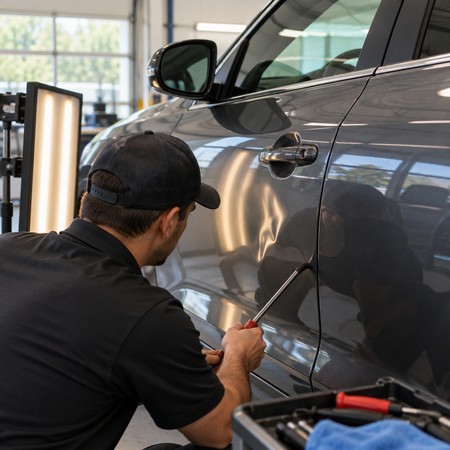
Technicians start by looking at the dent under special lighting. The reflection shows how deep the dent is, where the metal has stretched, and whether a crease runs through it. A flat, smooth dent looks like a gentle dip in the reflection. A crease looks like a sharp bend in the lines.
Next comes a close look at the paint. Chips, cracks, or flaking around the edge are warning signs, because moving metal under broken paint can make the damage worse. If the paint looks smooth and unbroken, the odds of a clean paintless repair go up.
Last, the technician checks access. Can a tool reach behind the panel, or will glue pulling be needed? Knowing this early saves time and helps give you an accurate quote. It also helps set honest expectations about how close to perfect the finish can get.
How Technicians Judge Large Dents Before Starting
Technicians start by looking at the dent under special lighting. The reflection shows how deep the dent is, where the metal has stretched, and whether a crease runs through it. A flat, smooth dent looks like a gentle dip in the reflection. A crease looks like a sharp bend in the lines.
Next comes a close look at the paint. Chips, cracks, or flaking around the edge are warning signs, because moving metal under broken paint can make the damage worse. If the paint looks smooth and unbroken, the odds of a clean paintless repair go up.
Last, the technician checks access. Can a tool reach behind the panel, or will glue pulling be needed? Knowing this early saves time and helps give you an accurate quote. It also helps set honest expectations about how close to perfect the finish can get.
Large dents and wide creases get repaired from behind the panel, slowly and in stages. A technician reads the reflection lines first, then sets the metal back using small pushes instead of one big pull. That patience matters, because stretching the steel too fast can leave a ripple that shows in sunlight. Most panels respond well when the paint is still intact.
Body lines are the toughest spot, since the crease gives the panel its shape. Repairing one takes steady work along both sides of the ridge until the edge looks sharp again. Some creases are too sharp or the paint has cracked, and a technician will tell you that right away. If you are unsure, upload 2 photos of the damage and our team will let you know if paintless repair is a good fit.
Why Deep Creases Take More Time and Skill
A crease is more than a deep dent. When metal folds sharply, it can stretch and harden along the fold, and that makes it resist being moved. Pushing too hard in one spot can leave a mark or push the metal too high. For that reason, a technician works a crease in many small movements, easing the fold open a little at a time.
Lighting is a big part of the process. Reflection boards show the fold as a bent line in the reflection, and the technician watches that line straighten as the work goes on. Small tapping tools then level the area around the crease so it blends into the rest of the panel. This stage can take longer than the main pushing, and it is where much of the finish quality comes from.
Results can vary. A fresh crease on a flexible panel may come out almost perfect. An older crease, or one where the paint has started to crack along the fold, may only improve part of the way. A technician will tell you what is realistic. If paintless repair cannot give a clean result, you will hear that up front, so you can decide what to do next.
Final Checks Before You Drive Your Vehicle Home
Some large dents sit on panels where there is no way to get a tool behind the metal. Double-layered doors, roof rails, and areas with bracing close to the skin can block a pick or rod. In those spots, a technician may use glue pulling instead, which draws the metal out from the front without drilling or cutting.
Glue tabs are attached to the dent, then pulled in small, controlled steps. Large dents often need several rounds, with different tab sizes placed across the damage. The goal is to bring the metal up slowly so it does not rise too high or stretch further.
After each pull, the technician checks the panel in the light and taps down any small high spots. The adhesive lifts off cleanly and leaves the paint as it was. This approach lets many people avoid disassembly and repainting on panels that once seemed out of reach.
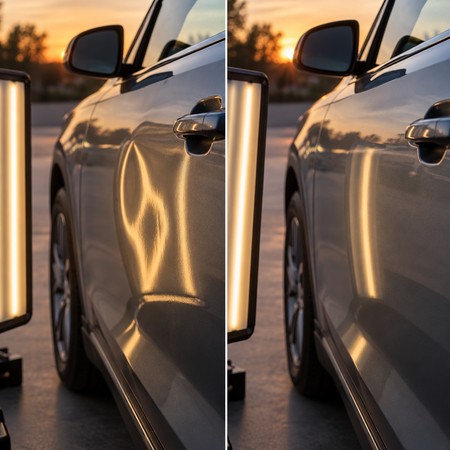
The last stage of a large dent repair is where the work either looks right or does not. The technician walks around the panel, checking how light moves across it from several angles. Any low spot or tiny high spot shows up as a wobble in the reflection, and it gets tapped out until the surface runs smooth from edge to edge. This check often takes longer than people expect, and rushing it is how a repair ends up noticeable.
Once the panel looks right, the technician compares it to the matching side of the vehicle to confirm the body line matches. The factory paint stays in place, so the finish is the same one your vehicle left the plant with. Because nothing is painted or filled, the repair is not reported to CarFax. Most dents are repaired in one day, either in our shop or with mobile service.
What to Expect When You Send Photos
The easiest way to find out whether your dent qualifies is to send photos. At Tennessee Valley Dent Repair, you upload two clear pictures of the damage along with your vehicle information, and a technician looks them over. If the dent is a good fit for paintless repair, you get a quote back. If it is not, you get an honest answer instead of a sales pitch.
For better photos, wash the area first and shoot in shade or soft light so reflections do not hide the shape of the dent. Take one picture straight on and one from the side at a slight angle. If there is any chipped or cracked paint, make sure it shows. Those details help the technician give you a more accurate answer the first time.
Most dents that qualify are repaired in one day, either in our shop or through mobile service. There is no painting, no filler, and no new parts, so the factory finish stays in place. The repair is also not reported to CarFax, which helps the vehicle keep its value. When you are ready, upload two photos for a quote, or give our team a call during business hours.

Tennessee Valley Dent Repair
Paintless Dent Repair & Door Ding Repair
GET NEW ARTICLES BY EMAIL
Sign up for new articles on dent repair, hail damage, and simple ways to protect your vehicle.
GET NEW ARTICLES BY EMAIL
Sign up for new articles on dent repair, hail damage, and simple ways to protect your vehicle.
Contact Info
Service Hours
Social Media
Mon-Fri: 8:00AM - 6:00PM CST
Saturday: Closed
Sunday: Closed



Licensed & Insured
Connect With Our Socials
Contact Info
Service Hours
Mon-Fri: 8:00AM - 6:00PM CST
Saturday: Closed
Sunday: Closed
Social Media
Licensed & Insured
©2026 Tennessee Valley Dent Repair
Powered by: Customers Plus
Powered by: Customers Plus
Powered by: Customers Plus